Lyrics
Полный текст песни «Antoshka» с английским переводом.
Антошка, Антошка, пойдём копать картошку! Антошка, Антошка, пойдём копать картошку! Тили-тили, трали-вали, это мы не проходили, это нам не задавали! Парам-пам-пам, парам-пам-пам!
#Transliteration
Antoshka, Antoshka, poydyom kopat' kartoshku! Antoshka, Antoshka, poydyom kopat' kartoshku! Tili-tili, trali-vali, eto my ne prokhodili, eto nam ne zadavali! Param-pam-pam, param-pam-pam!
#English translation
Antoshka, Antoshka, let's go dig potatoes! Antoshka, Antoshka, let's go dig potatoes! Tili-tili, trali-vali, "we haven't studied that, that wasn't set for us!" Param-pam-pam, param-pam-pam!
#Rights
The words of this song are by Yuri Entin and are still in copyright. They are reproduced here, credited, for family and classroom singing; no reuse licence has been obtained, and nothing on this page may be copied further. Rightsholders can ask for a correction or removal — see lyrics & credits.
Antoshka at a glance
- Country of origin
- 🇷🇺 Russia
- Sung in
- Russian
- Words by
- Yuri Entin
- First known
- 1969, "Vesyolaya Karusel" No. 1 (Soyuzmultfilm); music by Vladimir Shainsky (1925–2017)
- Best for ages
- 2–7
- Mood
- playful
- Last updated
- 27 August 2026
Meaning and origin
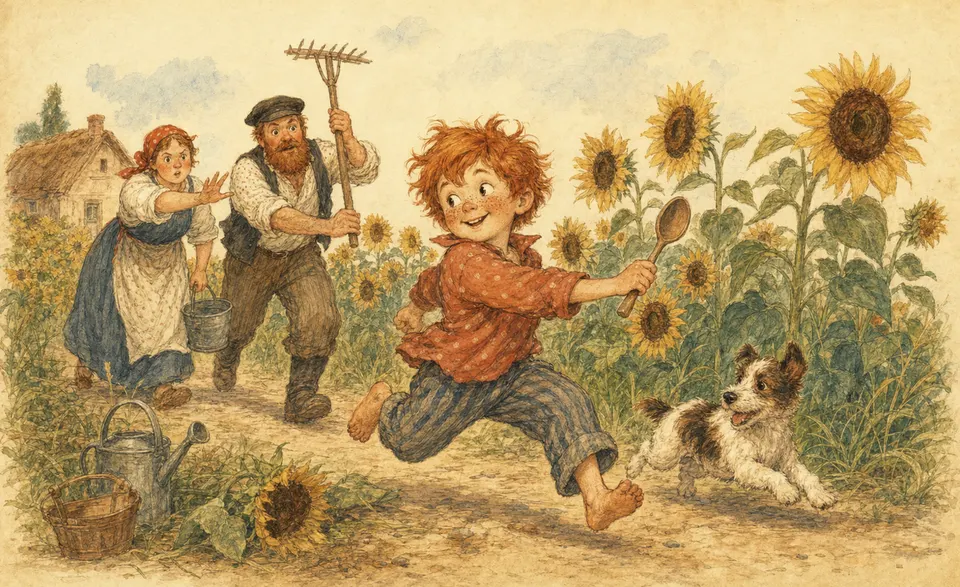
Generations of Soviet and Russian children have laughed at Antoshka, and the joke still lands. The others keep calling him out to work — Antoshka, Antoshka, let’s go dig potatoes! — and he keeps slipping the summons with the perfect schoolboy’s excuse: we haven’t covered that, it wasn’t set for us. The catch, of course, is that when a giant spoon comes out and it is time to eat, Antoshka is first in line. It is a warm, knowing little portrait of every child who is tireless at play and mysteriously exhausted by chores.
The song comes from Soviet animation. It featured in 1969 in the very first issue of Vesyolaya Karusel (“Merry-Go-Round”), an anthology of short cartoons from the Soyuzmultfilm studio, in a segment directed by Leonid Nosyrev. Nosyrev recalled wanting Antoshka to be red-haired and sunny, “sitting somewhere in nature under a sunflower” — an image he traced to a sunflower he had tried to bend as a child. The Russian Wikipedia article on the film credits the music to Vladimir Shainsky and the words to Yuri Entin, and names Margarita Korabelnikova as Antoshka’s singing voice. The nonsense refrain — tili-tili, trali-vali — is half the fun, a lazy sing-song lilt that fits its hero perfectly.
Common questions
- What is "Antoshka" about?
- A cheerfully lazy boy. Everyone calls "Antoshka, Antoshka, let's go dig potatoes!" — and he wriggles out of it with the excuse "we haven't covered that, that wasn't set for us". But when it is time to get out a big spoon for lunch, Antoshka is suddenly very willing. It is a gentle, funny poke at dodging work.
- Where does "Antoshka" come from?
- From Soviet animation. It appeared in 1969 in the first issue of the cartoon almanac "Vesyolaya Karusel" (Merry-Go-Round), made at the Soyuzmultfilm studio, in a short directed by Leonid Nosyrev. The Russian Wikipedia article on the film credits the music to Vladimir Shainsky and the words to Yuri Entin.
- What do the nonsense lines mean?
- "Tili-tili, trali-vali" are playful nonsense syllables, like "fiddle-dee-dee". They fill the refrain with a sing-song, silly lilt while Antoshka makes his lazy excuses.