Lyrics
Der vollständige Liedtext von „Zehn kleine Zappelmänner“ mit englischer Übersetzung.
Zehn kleine Zappelmänner zappeln hin und her, zehn kleinen Zappelmännern fällt das gar nicht schwer.
#Zehn kleine Zappelmänner zappeln auf und nieder, zehn kleine Zappelmänner tun das immer wieder.
#Zehn kleine Zappelmänner zappeln ringsherum, zehn kleine Zappelmänner fallen plötzlich um.
#Zehn kleine Zappelmänner kriechen ins Versteck, zehn kleine Zappelmänner sind auf einmal weg.
#Zehn kleine Zappelmänner sind nun wieder da, zehn kleine Zappelmänner rufen laut: „Hurra!“
#English translation
Ten little fidget men wiggle to and fro, ten little fidget men find it easy to do. Ten little fidget men wiggle up and down, ten little fidget men do it again and again. Ten little fidget men wiggle round and round, ten little fidget men suddenly fall down. Ten little fidget men creep into hiding, ten little fidget men all at once are gone. Ten little fidget men now are back once more, ten little fidget men shout out loud: "Hooray!"
#Zehn kleine Zappelmänner at a glance
- Country of origin
- 🇩🇪 Germany
- Sung in
- German
- Words by
- Traditional
- First known
- Traditional; the cited source credits the text as "traditionell" and gives no date
- Best for ages
- 2–7
- Mood
- playful, traditional
- Last updated
- 27 August 2026
Meaning and origin
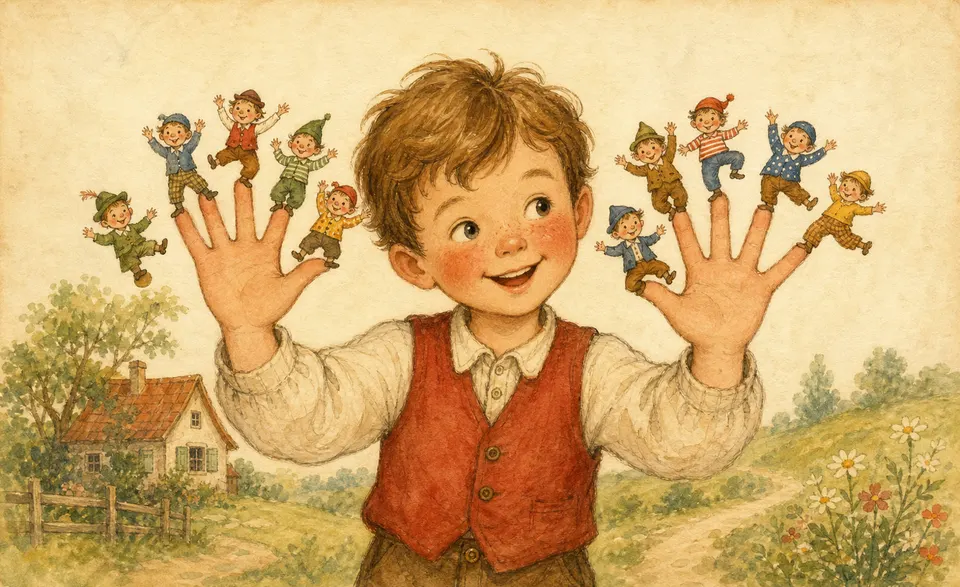
This is a finger game before it is a song. The “ten little fidget men” are the child’s own ten fingers, and every verse tells them what to do: wiggle to and fro, bob up and down, spin around, topple over, then creep out of sight behind the back before springing out again with a shout of Hurra! Half the fun is that the singer performs the whole thing on their own hands as they go.
The name says it all. Zappeln means to fidget or wriggle, so the Zappelmänner are ten restless little figures — which is precisely what ten waving fingers look like. The rhyme gives that natural wiggling a shape and a story, and teaches, in passing, the small art of making your fingers do what you tell them.
Like most finger-plays, it has no known author. The source we cite credits the text simply as traditionell and gives no date, and we found no record of when it was first written down. It remains one of the most popular German finger games of all — a first lesson in using your hands, disguised as a game about ten little men who cannot sit still.
Common questions
- How do you play "Zehn kleine Zappelmänner"?
- With your ten fingers. They are the "Zappelmänner" — little fidget men — and you make them do whatever the verse says: wiggle back and forth, bob up and down, dance in a circle, fall over, creep into hiding behind your back, then pop out again with a loud "Hurra!" It is a finger game, meant to be acted out rather than just sung.
- What does "Zappelmänner" mean?
- Roughly "fidget men" or "wiggle men". "Zappeln" means to fidget, squirm or wriggle, so the ten Zappelmänner are ten restless little figures — which is exactly what ten waggling fingers look like to a small child.
- How old is "Zehn kleine Zappelmänner", and who wrote it?
- The author is not known. Our source, the Sternschnuppe song collection, credits the text simply as "traditionell" and gives no date, and we found no record of when it was first written down. It remains one of the most popular German finger games for very young children.