Lyrics
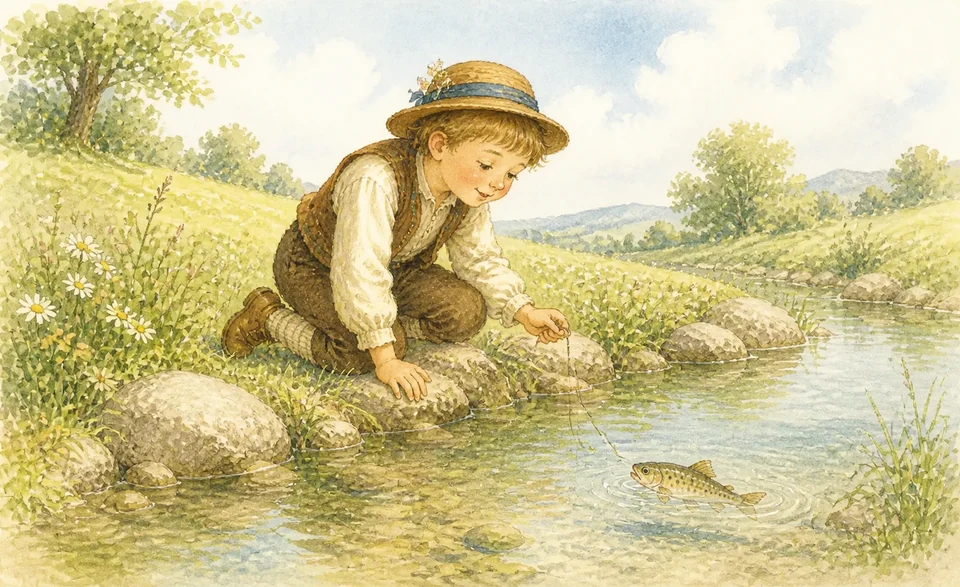
One, two, three, four, five, Once I caught a fish alive. Six, seven, eight, nine, ten, Then I let it go again. Why did you let it go? Because it bit my finger so. Which finger did it bite? This little finger on my right.
#One, Two, Three, Four, Five, Once I Caught a Fish Alive at a glance
- Country of origin
- 🌐 Unknown
- Sung in
- English
- Words by
- Traditional
- First known
- Fish-and-finger forms collected in Pennsylvania and Ohio, printed 1888
- Best for ages
- 2–6
- Mood
- counting, educational, playful, traditional
- Last updated
- 27 August 2026
How to sing it
- Begin slowly so everyone can hear the repeated words and the action cue.
- Hold up one finger for each number, mime catching and releasing the fish, then point to the little finger on the right.
- Repeat the song once and invite a different child to lead the cues.
Meaning and origin
The rhyme begins with two clean runs of numbers—one to five, then six to ten—and uses them to frame a question-and-answer story. A creature is caught, released and then blamed for biting a finger. The final answer points to the little finger on the right, giving the counting a concrete ending that children can show with their own hands.
Henry Carrington Bolton printed two fish-and-finger variants in 1888, next to a hare form (“Once I caught a hare alive”) reported from Missouri and Nebraska. His Pittsburgh, Pennsylvania text has the fish bite the finger but stops there; his Ohio text is the one that asks “Which finger did it bite?” and answers “The little finger on the right.” Neither example provides one source for every line of the now-familiar text. This page therefore labels its displayed wording as a composite instead of presenting it as a verbatim historical transcription.
That stability is what makes the rhyme easy to learn. Children can raise one finger for each number, mime catching and releasing the animal, then answer the final question by pointing to the correct little finger. Once the fish round is secure, swapping in another creature — as the hare form already did in the 1880s — shows how a traditional rhyme can accept a small change without losing its recognizable shape.
Common questions
- Is the fish verse the oldest form of One, Two, Three, Four, Five?
- No single source was found for the complete familiar wording. Henry Carrington Bolton printed two fish-and-finger variants in 1888 — one from Pittsburgh, Pennsylvania, that stops at the bitten finger, and one from Ohio that adds the question of which finger and the answer “the little finger on the right” — alongside a related counting-out form about catching a hare, so this page labels its text as a composite.
- Why does the rhyme end with the little finger on the right?
- The final question asks which finger the fish bit, and the answer identifies the right little finger. Pointing to it gives the question-and-answer rhyme a clear final gesture and connects counting with a body-part word.