Lyrics
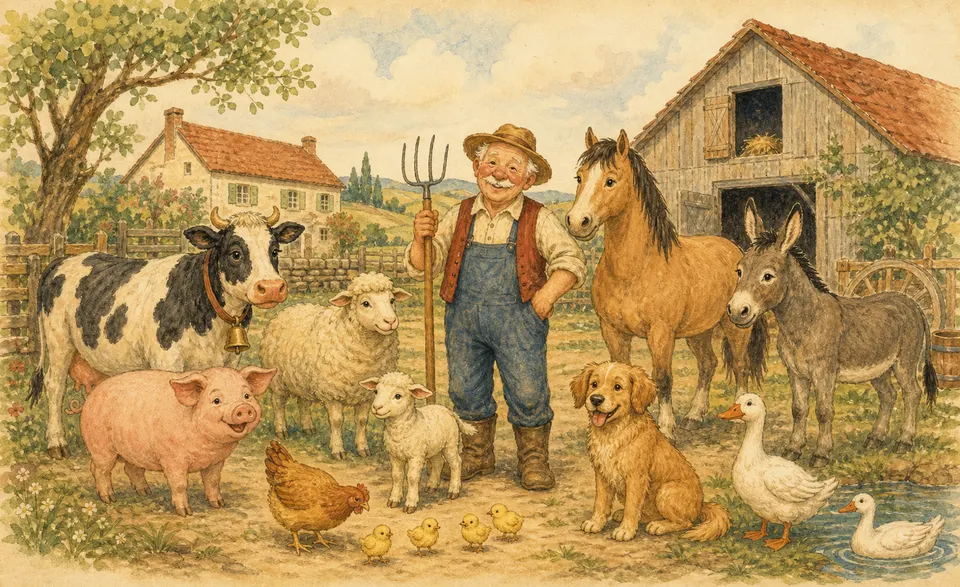
Old MacDonald had a farm, E-I-E-I-O! And on his farm he had a cow, E-I-E-I-O! With a moo-moo here and a moo-moo there, Here a moo, there a moo, everywhere a moo-moo. Old MacDonald had a farm, E-I-E-I-O!
#Old MacDonald Had a Farm at a glance
- Country of origin
- 🌐 Unknown
- Sung in
- English
- Words by
- Traditional
- First known
- ancestor 1706 (d’Urfey); standard tune and the name "MacDonald" first on recordings of 1925–27
- Best for ages
- 2–7
- Mood
- playful, traditional, educational
- Last updated
- 27 August 2026
How to sing it
- Pick an animal for each verse and make its sound together — moo, baa, oink, quack.
- Keep every earlier animal's sound and add the new one on top each time, so the song grows.
- Let a different child choose the next animal each round.
Meaning and origin
This is a machine for making noise, and children love it for exactly that. Pick an animal, make its sound, then keep it and add another, and another, until the song is a farmyard of overlapping moos and baas and quacks. It is a cumulative song — one built to grow — and the growing is the whole point.
Its history is longer than its silliness suggests. A song with the same question-and-answer, animal-by-animal shape turns up as early as 1706, in a stage work by Thomas d’Urfey, and again in his songbook of 1719. Through the 1800s and early 1900s folk collectors wrote down farmyard versions all over England, under names like “The Farmyard Song”. The farmer’s name was still unsettled in 1917, when the soldiers’ songbook Tommy’s Tunes printed a version called “Ohio” about “Old Macdougal”; he only became “Old MacDonald”, with the tune everyone now uses, on American recordings — the Sam Patterson Trio in 1925 and Gid Tanner and His Skillet Lickers in 1927 — which is why a song with English roots and centuries of life on both sides of the Atlantic is given no single country here.
The “E-I-E-I-O” that stitches it together means nothing at all. Older versions had quite different nonsense in its place; this is simply the refrain that won. What survives across three centuries is not the words but the game: name a beast, give it a voice, and pile them up until everyone runs out of animals or breath.
Common questions
- How old is "Old MacDonald"?
- Older than it looks. A song with the same shape — "In the Fields in Frost and Snow" — appears in Thomas d'Urfey's stage work of 1706 and his "Wit and Mirth" of 1719. Folk collectors wrote down farmyard versions across England around 1900; the 1917 soldiers' songbook "Tommy's Tunes" has a version called "Ohio" whose farmer is "Old Macdougal"; and the recordings by the Sam Patterson Trio (1925) and Gid Tanner and His Skillet Lickers (1927) may be the first with today's tune and the name "Old MacDonald".
- Where is "Old MacDonald" from?
- No single country can claim it, which is why this page leaves the country unknown. Its earliest ancestor is English — d'Urfey's 1706 stage song — and it then lived as a folk song in Great Britain, Ireland and North America for hundreds of years in many forms, before the version everyone now sings was standardised in the twentieth century, with the first recordings of the standard tune and name made in the United States.
- What is a "cumulative" song?
- One that grows as it goes. Each new verse of "Old MacDonald" adds another animal and its sound, and you repeat all the earlier sounds too — so the song gets longer and sillier with every animal, which is half the fun.
- What does "E-I-E-I-O" mean?
- Nothing in particular — it is a nonsense refrain that carries the tune between verses. Older versions had different filler words entirely; the "E-I-E-I-O" we sing is simply the one that stuck.