Lyrics
Celotno besedilo pesmi »Huda mravljica« z angleškim prevodom.
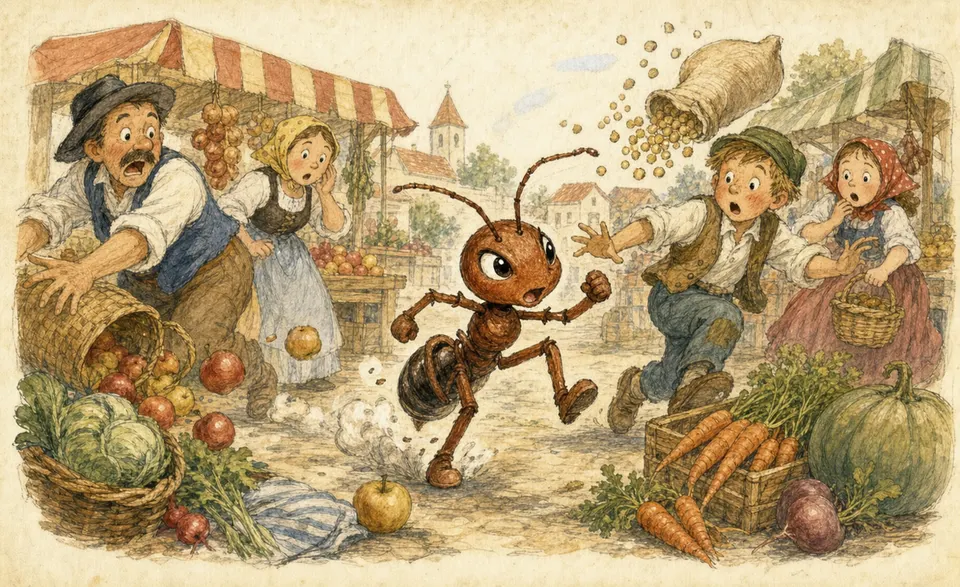
Bila je huda mravljica, šest črnih nog je imela, je migala, je vohala, je čisto ponorela. Bila je huda mravljica, po trgu je hodila, lončarju je čez piskre šla pa vse mu je pobila.
#In kamor koli je prišla, so vsi pred njo bežali, je pokalo, je stokalo, pod njenimi stopali.
#Oj mravljica, požrešnica, le kaj je naredila? Še bika je pohrustala, roge je le pustila.
#Seveda, to je čisto res: zakaj se bik šopiri? Šest črnih nog ima mravljica, bik pa ima le štiri.
#Če slišiš hudo mravljico po svetu godrnjati, obrni se in zbeži proč, kar zmorejo podplati!
#English translation
There was a fierce little ant, she had six black legs, she wiggled, she sniffed, she went completely mad. There was a fierce little ant, she walked about the market, she stormed over the potter's pots and smashed them all to bits. And wherever she came, everyone fled before her; it cracked and it groaned beneath her feet. Oh, greedy little ant, whatever did she do? She even crunched up an ox, and left only the horns. Of course, this is quite true: so why does the ox strut about? The ant has six black legs, but the ox has only four. If you hear the fierce ant grumbling through the world, turn around and flee away, as fast as your soles can go!
#Rights
The words of this song are by Branko Rudolf and are still in copyright. They are reproduced here, credited, for family and classroom singing; no reuse licence has been obtained, and nothing on this page may be copied further. Rightsholders can ask for a correction or removal — see lyrics & credits.
Huda mravljica at a glance
- Country of origin
- 🇸🇮 Slovenia
- Sung in
- Slovenian
- Words by
- Branko Rudolf
- First known
- poem first published 1955 in the collection "Zamorček in ladjica"
- Best for ages
- 2–7
- Mood
- playful
- Last updated
- 27 August 2026
Meaning and origin
This is a gloriously silly song built on one big joke: the most terrifying creature in the world turns out to be an ant. She has six black legs, wiggles and sniffs and goes quite mad, and rampages through the market smashing the potter’s pots to bits. Wherever she goes people flee, the ground cracking beneath her feet, and — greedy gobbler that she is — she even crunches up an entire ox, leaving only the horns behind. The comedy is all in the mismatch between the tiny insect and the enormous havoc.
Best of all is the mock-logical moral. Why, the song asks, does the ox strut about so proudly, when the ant has six legs and the ox only four? By that arithmetic the ant plainly outranks the ox — so if you ever hear her grumbling by, you had better flee as fast as your feet can carry you.
Unlike most of the songs in this book, this one has an author. The words are by Branko Rudolf (1904–1987), a poet, essayist and art critic from Slovenske Konjice who for thirty years directed the art gallery in Maribor. The poem appeared in 1955 in his collection of children’s verse Zamorček in ladjica, and in 1969 a further collection of his poems and tales was published under the ant’s own name. Marijan Vodopivec set it to music, and it is sung by Romana Krajnčan. The text above follows the 1998 Mladinska knjiga edition as transcribed on Wikivir.
Common questions
- What is "Huda mravljica" about?
- A ferociously fierce little ant. She has six black legs, wiggles and sniffs and goes quite mad, storms through the market smashing a potter's pots, makes everyone flee, and — greedy gobbler that she is — even crunches up a whole ox, leaving only the horns. The joke is that this terror of the world is an ant.
- What's the joke at the end?
- A mock-logical one: why does the ox strut about so proudly, when the ant has six black legs and the ox only four? By ant-arithmetic, the tiny ant clearly outranks the ox — so you had better flee if you hear her grumbling by.
- Who wrote "Huda mravljica"?
- The poem is by the Slovenian poet, essayist and art critic Branko Rudolf (1904–1987). It was first published in 1955 in his collection of children's poems "Zamorček in ladjica", and in 1969 gave its name to a further collection of his poems and tales. The composer Marijan Vodopivec set it to music, and it is performed by the singer Romana Krajnčan. Because Rudolf died in 1987, the words are still in copyright.