Lyrics
A letra completa de «Atirei o Pau no Gato» com tradução em inglês.
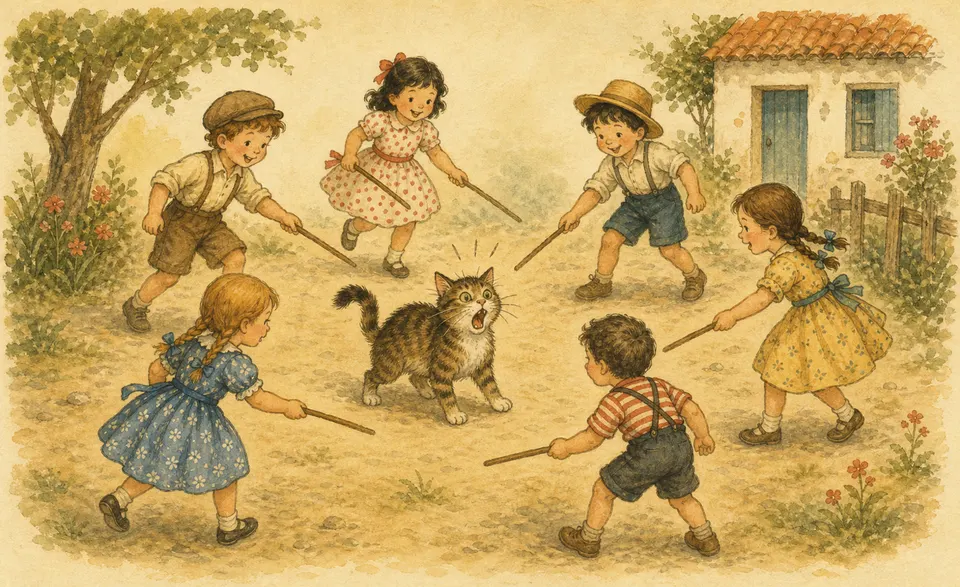
Atirei o pau no gato-to Mas o gato-to não morreu-reu-reu Dona Chica-ca admirou-se-se do berro, do berro que o gato deu: Miau!
#English translation
I threw the stick at the cat-cat but the cat-cat didn't die-die-die Lady Chica-ca was amazed-amazed at the yowl, at the yowl the cat gave: Meow!
#Atirei o Pau no Gato at a glance
- Country of origin
- 🇧🇷 Brazil
- Sung in
- Portuguese
- Words by
- Traditional
- First known
- not documented; no author recorded
- Best for ages
- 2–7
- Mood
- playful, traditional
- Last updated
- 27 August 2026
Meaning and origin
This is one of the most familiar cantigas de roda — ring-game songs — in Brazil, the kind children sing while circling hand in hand. Its charm is largely in the sound: the stuttering, echoing syllables (gato-to, morreu-reu-reu) make it fun to sing fast, and the whole thing builds to a single loud Miau! that everyone shouts together. Notably, the cat in the rhyme is not harmed — the joke is its outraged, surprising yowl, which astonishes the onlooking Dona Chica.
Who wrote it, and when, is not documented: the lyrics site that carries it describes it only as one of Brazil’s best-known popular songs, with no author. In recent years its imagery — throwing a stick at a cat — has drawn debate about violent content in children’s culture, and it has been rewritten into gentler forms that promote respect for animals, most famously by the Galinha Pintadinha children’s franchise. Today both versions coexist: the old nonsense rhyme and its kinder modern cousin, sung side by side in the same playgrounds.
Common questions
- What does "Atirei o pau no gato" say?
- In its traditional form: "I threw the stick at the cat, but the cat didn't die; Dona Chica was amazed at the yowl the cat gave — meow!" It is a nonsense ring-game rhyme, and (importantly) the cat is not hurt — the joke is the loud, indignant meow.
- Where is "Atirei o Pau no Gato" from?
- It is a Brazilian "cantiga de roda" — a children's ring or circle song — and one of the best-known popular songs in Brazil. No author is recorded and its origin and date are not documented in the source that carries it.
- Is there a non-violent version?
- Yes. Because the words describe throwing a stick at a cat, the song has become the subject of debate about violent content in children's culture, and alternative versions promoting respect for animals have been written — most famously by the "Galinha Pintadinha" children's brand. Both the old and new forms are sung today.