Lyrics
Les paroles complètes de « Alouette » avec traduction en anglais.
Alouette, gentille alouette, Alouette, je te plumerai. Je te plumerai la tête, Je te plumerai la tête. Et la tête, et la tête, Alouette, alouette, ah!
#English translation
Lark, gentle lark, Lark, I will pluck you. I will pluck your head, I will pluck your head. And the head, and the head, Lark, lark, ah!
#Alouette at a glance
- Country of origin
- 🇨🇦 Canada
- Sung in
- French
- Words by
- Traditional
- First known
- first printed 1879 (Montreal, McGill College pocket song book)
- Best for ages
- 2–7
- Mood
- playful, traditional
- Last updated
- 27 August 2026
How to sing it
- Sing it as a call-and-response — a leader names a body part and the group echoes it back.
- Add a new part each round (head, beak, neck, wings…) and pile up all the previous ones, like "The Twelve Days of Christmas".
- Speed up as the list grows longer; the fun is in keeping the whole chain going.
Meaning and origin
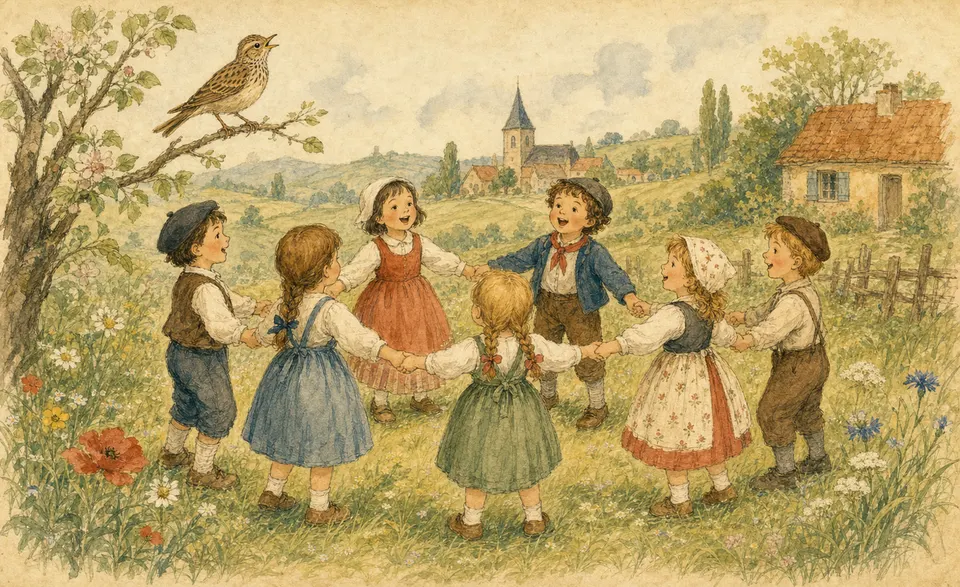
This is one of the most famous French-language songs in the world, and one of the most cheerfully absurd. Addressed to a “gentle lark”, it announces, with great warmth, that the singer is going to pluck it — and then sets about doing so part by part: the head, the beak, the neck, the wings, and onward. Each verse adds a new body part and then rattles back through all the earlier ones, so the song grows longer and faster with every round, like “The Twelve Days of Christmas”.
Despite its Frenchness, it is Canadian. The Canadian Encyclopedia records its first known printing, as “Alouetté”, in A Pocket Song Book for the Use of Students and Graduates of McGill College (Montreal, 1879), and the first known printing in France only in 1893, in Julien Tiersot’s Revue des traditions populaires. The folklorist Marius Barbeau thought the song had come from France, but no earlier French text has been found; Wikipedia’s account links it instead to the voyageurs of the North American fur trade, who sang to keep time as they paddled. The lark itself is the morning bird of French folk song — the one that wakes sleepers, not always welcome — which may be the sly joke behind threatening to pluck it.
It works because it is a game, not a story. Sung as call-and-response, with a leader naming each part and the group shouting it back, it turns a room of children (or soldiers, or sports fans) into one big cheerful machine for remembering a list. Allied soldiers who met it in France in the First World War carried it home, and it has served ever since as an unofficial anthem of French Canada — a nation represented, of all things, by a song about plucking a bird.
Common questions
- What does "Alouette" actually say?
- It is cheerfully gruesome: "Lark, gentle lark, I will pluck you." The singer then works through the bird's body part by part — I'll pluck your head, your beak, your neck, and so on — piling each new part on top of the last. It is a list-and-repeat game, not really about the poor lark at all.
- Where is "Alouette" from?
- From French Canada. Although many assume it is French, its first known printing is in "A Pocket Song Book for the Use of Students and Graduates of McGill College" (Montreal, 1879); the first known printing in France followed in 1893. Folklorists have also linked it to the songs of the voyageurs of the North American fur trade.
- Why a lark?
- In French folk tradition the lark is the morning bird that wakes sleepers — sometimes unwelcomely — which may be why the song playfully threatens to pluck it. Today it is sung as a light-hearted game and stands as an unofficial anthem of French Canada.