Lyrics
Celotno besedilo pesmi »Prebudil se je rano sosedov bosopet« z angleškim prevodom.
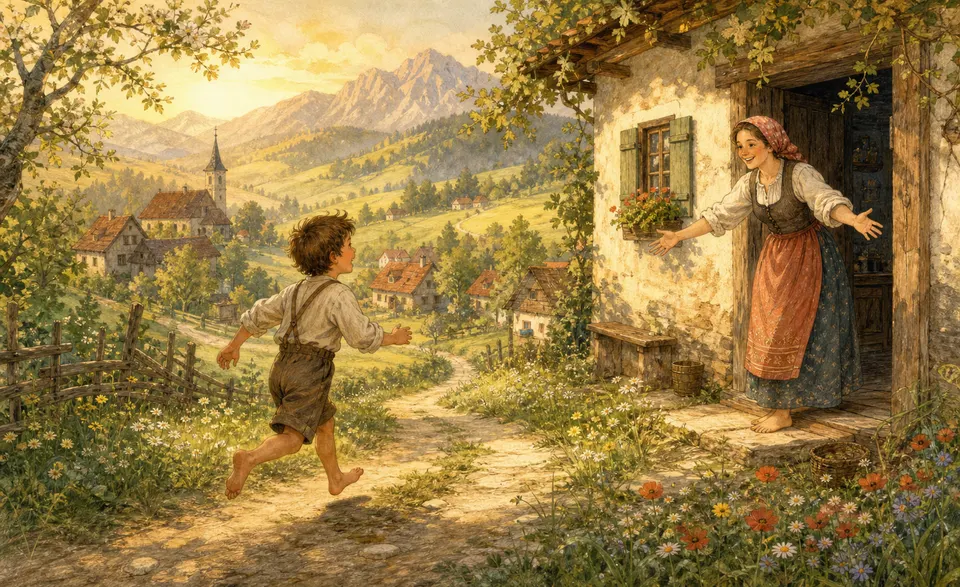
Prebudil se je rano sosedov bosopet, poljubil je še mamo in mahnil jo je v svet.
#Cvetlice je nabiral, sinice je plašil, maline je obiral, za zajci se podil.
#A, glej, še v tisti noči pritekel je nazaj, tja v mamino naročje, preplašen, da je kaj.
#Tako je rekel sosed, da v svet bo že še šel; a mamico da svojo bo vedno s sabo vzel.
#English translation
The neighbour's barefoot boy woke up early, kissed his mummy goodbye and set off into the world. He picked the flowers, he scared the titmice, he picked the raspberries, he chased after the rabbits. But look — still that very night he came running back, there into his mummy's arms, frightened out of his wits. And so the neighbour's boy said that he'd go into the world one day after all, but that his mummy — he'd always take her with him.
#Rights
The words of this song are by Jože Humer and are still in copyright. They are reproduced here, credited, for family and classroom singing; no reuse licence has been obtained, and nothing on this page may be copied further. Rightsholders can ask for a correction or removal — see lyrics & credits.
Prebudil se je rano sosedov bosopet at a glance
- Country of origin
- 🇸🇮 Slovenia
- Sung in
- Slovenian
- Words by
- Jože Humer
- First known
- words by Jože Humer (1936–2012), set to Mozart's Allegro in F major, K. 1c; also known as "Mali potepuh"
- Best for ages
- 2–7
- Mood
- playful, traditional
- Last updated
- 27 August 2026
Meaning and origin
This is a tender little song about the tug-of-war in every small child between the urge to explore and the need to be safe at home. The neighbour’s barefoot boy — a bosopet, running about without shoes — wakes early, kisses his mum goodbye, and marches boldly off “into the world”, where he has a fine day of it: picking flowers, scaring the titmice, picking raspberries, chasing after rabbits. It is childhood adventure at its sunniest.
But adventure has an evening. That very night the boy comes running back, thoroughly frightened, straight into his mother’s arms — and there he makes his peace with both sides of himself. He will go out into the world one day, he decides; he just isn’t going without his mummy. That gentle resolution, wanting both the wide world and the safety of home, is exactly how a small child feels, and the song holds the two together with great warmth.
The words are by Jože Humer (1936–2012), the Ljubljana lawyer-turned-choirmaster whose obituary credits him with several hundred compositions and a thousand adaptations of children’s song texts; he called this one Mali potepuh, “The Little Wanderer”. The tune is not his own and not Slovenian: he wrote his verses to fit Mozart’s Allegro in F major, K. 1c, one of the miniature keyboard pieces Mozart produced as a very small boy. Slovenian schools still teach it that way round — listen to the Mozart first, then sing the little wanderer over the top of it — and the text printed here follows one such school worksheet.
Common questions
- What is "Prebudil se je rano sosedov bosopet" about?
- A little adventurer and his change of heart. The neighbour's barefoot boy wakes early, kisses his mum goodbye, and marches off "into the world" — picking flowers, scaring the titmice, picking raspberries, chasing after rabbits. But that very night he comes running back, frightened, into his mother's arms. In the end he decides he will go into the world one day after all — but he'll always take his mummy with him.
- What does "bosopet" mean?
- "Bosopet" means "barefoot" (literally "bare-heel") — an affectionate word for a little boy running about without shoes, as country children once did.
- Who wrote "Prebudil se je rano sosedov bosopet"?
- The Slovenian words are by Jože Humer (1936–2012), the Ljubljana choirmaster and lyricist credited with over a thousand adaptations of children's songs, who titled this one "Mali potepuh" ("The Little Wanderer"). He did not write the tune: he set his words to an existing piece of music, Mozart's Allegro in F major, K. 1c.
- Is the tune really by Mozart?
- Yes — it is his Allegro in F major, K. 1c, one of the tiny keyboard pieces written when Mozart was a small child himself. Slovenian school materials teach the song exactly that way: listen to the Mozart piece first, then learn Humer's words to it.