Lyrics
Der vollständige Liedtext von „Hoppe, hoppe Reiter“ mit englischer Übersetzung.
Hoppe, hoppe, Reiter, wenn er fällt, dann schreit er. Fällt er in den Graben, fressen ihn die Raben. Fällt er in den Sumpf, dann macht der Reiter plumps!
#English translation
Bumpety-bump, little rider, when he falls, then he'll cry out. If he falls into the ditch, the ravens will eat him up. If he falls into the swamp, then the rider goes — plop!
#Hoppe, hoppe Reiter at a glance
- Country of origin
- 🇩🇪 Germany
- Sung in
- German
- Words by
- Traditional
- First known
- not dated in the sources consulted
- Best for ages
- 2–7
- Mood
- playful, traditional
- Last updated
- 27 August 2026
How to sing it
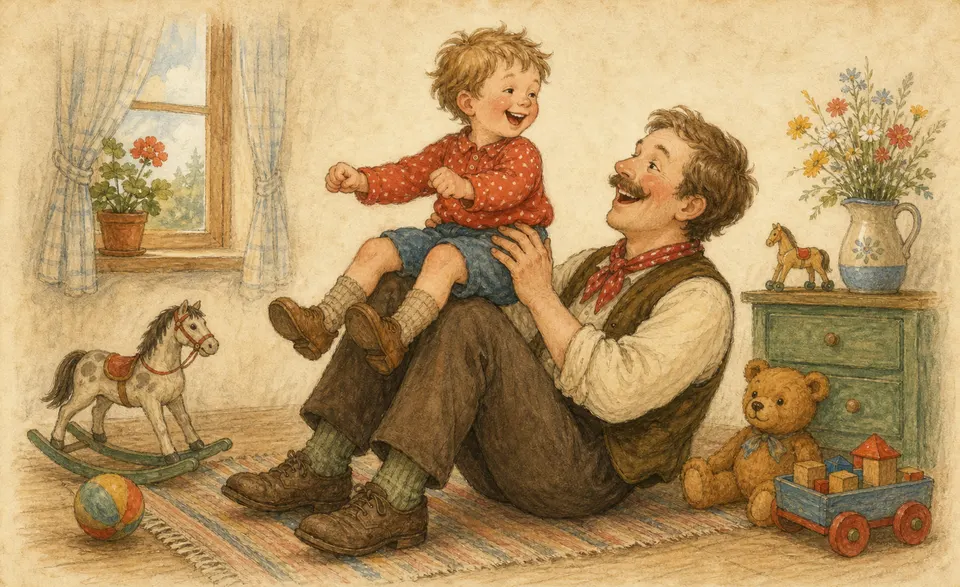
- Sit the child on your knees, facing you, and hold their hands like reins.
- Bounce them gently up and down in time as the "rider" trots along.
- On "plumps!" open your knees a little so the child dips down — then catch them safely by the hands.
Meaning and origin
Almost every German child meets this rhyme not sitting still but bouncing. It is a Kniereiterlied, a knee-riding song: the child perches on a grown-up’s knees, holds their hands like reins, and is jogged up and down like a rider on a horse, until the very last word — plumps! — when the knees open a little and the “rider” drops down before being caught. That small, safe fall is the whole point.
Read coldly, the words are alarming: the rider tumbles into a ditch and is eaten by ravens, or lands in a swamp with a splat. But nobody hears them as frightening. The mock danger is what charges the game — the child, held safely the whole time, gets the thrill of a fall with none of the risk, and greets the “plumps” with a shriek of delight rather than fear.
It is the most widespread knee-riding game in the German-speaking world, with versions recorded in Low German, in the Palatinate, Hesse and the Saarland, and in the Alemannic dialects of Switzerland. How old it is, the sources consulted do not say, and this page does not guess. Countless regional versions exist, but they all end the same way: a bounce, a mock catastrophe, and a laughing child caught just in time.
Common questions
- How do you play "Hoppe, hoppe Reiter"?
- It is a knee-riding game (a "Kniereiterlied"). You sit a small child on your knees, hold their hands like reins, and bounce them like a rider trotting along. On the final word, "plumps", you open your knees so the child drops a little way down before you catch them by the hands — the safe surprise that makes them shriek with laughter.
- Isn't the rhyme rather grim?
- On paper, yes — the rider falls in a ditch and the ravens eat him, or falls in the swamp with a "plumps". But it is not meant to frighten. The mock danger of the words is exactly what makes the little drop at the end so thrilling and funny for the child, who knows the safe hands are always there.
- How old and widespread is "Hoppe, hoppe Reiter"?
- It is the most widely known knee-riding game across the German-speaking world, with regional versions recorded from Low German-speaking northern Germany through the Palatinate, Hesse and the Saarland to Alemannic Switzerland. When it was first written down is not stated in the sources consulted, so this page gives it no date.