Lyrics
Der vollständige Liedtext von „Hänschen Klein“ mit englischer Übersetzung.
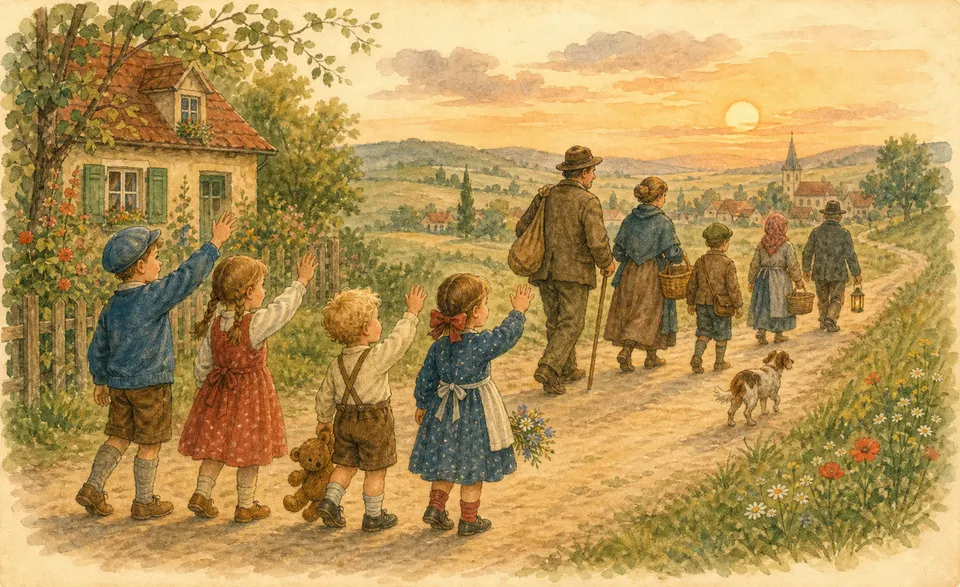
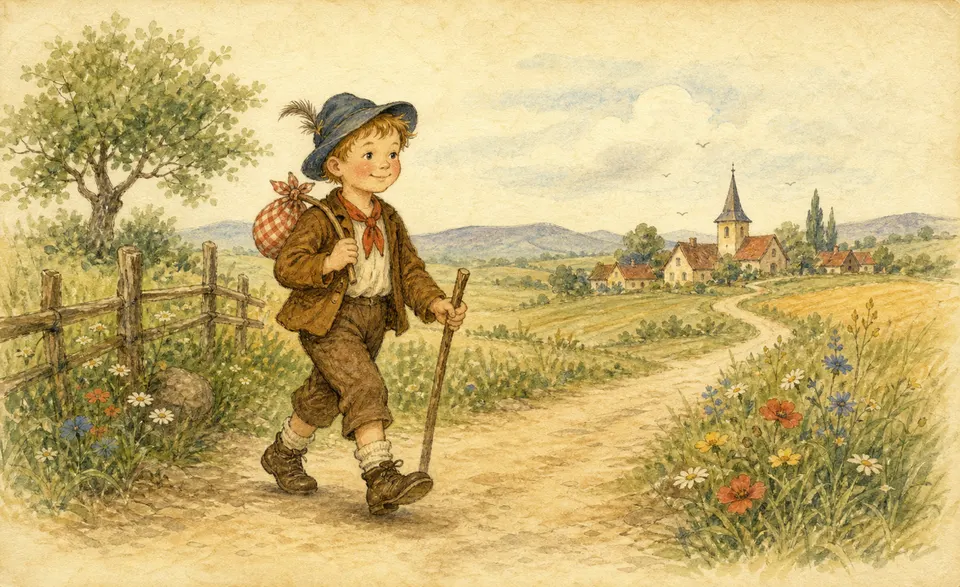
Hänschen klein ging allein in die weite Welt hinein. Stock und Hut steht ihm gut, ist gar wohlgemut. Aber Mutter weinet sehr, hat ja nun kein Hänschen mehr. „Wünsch dir Glück!“ sagt ihr Blick, „kehr nur bald zurück!“
#English translation
Little Hans went off alone out into the wide, wide world. Stick and hat suit him well, he is in the best of cheer. But his mother weeps and weeps — now she has no Hans at all. "Wish you luck," says her look, "only come back soon!"
#Hänschen Klein at a glance
- Country of origin
- 🇩🇪 Germany
- Sung in
- German
- Words by
- Franz Wiedemann
- First known
- 1860 (words first published, in the fourth edition of Wiedemann's "Samenkörner für Kinderherzen")
- Best for ages
- 2–7
- Mood
- traditional, calming
- Last updated
- 27 August 2026
Meaning and origin
This is one of the first songs German children learn — in the German-speaking world it has long been among the very first songs taught to children at all. Most people meet it as a gentle single verse: little Hans, cheerful with his stick and hat, walks off into the world, and his mother, left behind, weeps and asks only that he come home soon.
That tenderness is the short version’s doing. Franz Wiedemann, a Dresden teacher, published the words in 1860 and gave the song three verses and a much longer arc: Hans stays away for years and returns a grown man, so weathered and “tanned black on forehead and hand” that his own sister does not know him — only his mother recognises him at once. A shortened text was in circulation by the end of the nineteenth century; Otto Frömmel printed a two-verse version for kindergartens in 1900, and over time it shrank again to the single farewell verse sung today.
The tune is older than the words. It is written down as a dance melody in a manuscript dated 1784, was printed in 1807 as the hunting song “Fahret hin”, and Wiedemann marked his poem “Mel.: Fahret hin” from the start; English speakers know it as “Lightly Row”. It has had a strange afterlife, too: it is the melody HAL 9000 sings, slowing and faltering, as it is switched off in the German-language release of 2001: A Space Odyssey — a children’s song about leaving home turned into the sound of a machine’s last moments.
Common questions
- Who wrote "Hänschen Klein"?
- The words are by the Dresden teacher Franz Wiedemann (1821–1882), who published them in 1860 in the appendix "Alte Lieder, neue Worte" of the fourth edition of his collection "Samenkörner für Kinderherzen". The tune is older: it survives as a dance melody in a manuscript dated 1784, was printed in 1807 as the hunting song "Fahret hin", and Wiedemann's first printing simply notes "Mel.: Fahret hin". English speakers know the same melody as "Lightly Row".
- What is "Hänschen Klein" about?
- Little Hans (Hänschen) leaves home to see the wide world, cheerful with his walking stick and hat, while his mother weeps to see him go. In Wiedemann's original three-verse version he stays away for years and comes home grown and unrecognisable — only his mother knows him at once. The short version sung to small children keeps just the tender farewell.
- Why is the version children sing so short?
- The original had three verses. In 1900 Otto Frömmel printed a two-verse version for kindergartens, and today usually only the first verse is sung, which is why the modern song ends gently with the mother asking Hans to come back soon.
- Where else have I heard the tune?
- In its shortened form it has long been one of the very first songs taught to children across the German-speaking world. It is also the tune HAL 9000 sings while being shut down in the German-language release of the film "2001: A Space Odyssey", and the same melody carries well-known children's songs in Japan, Taiwan and Korea.