Lyrics
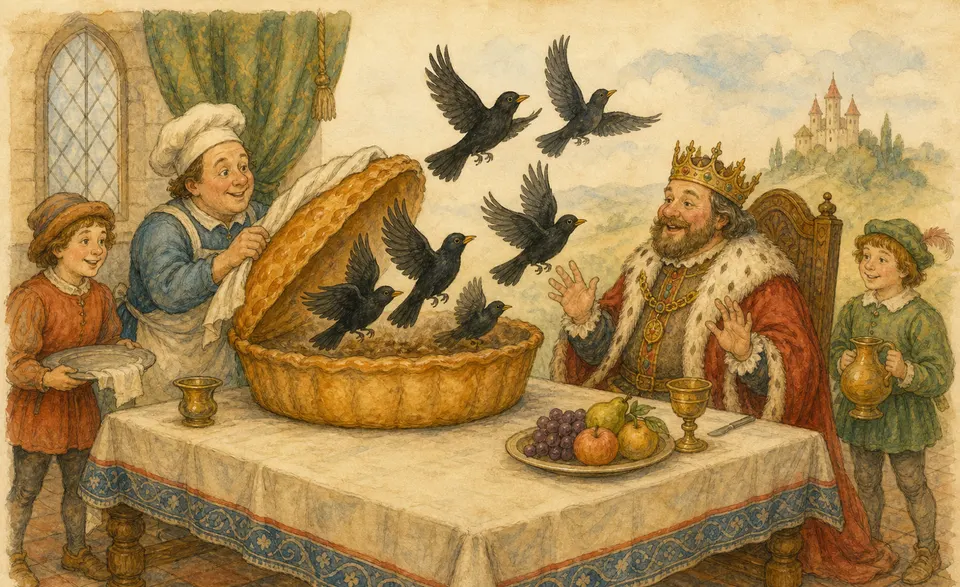
Sing a song of sixpence, a pocket full of rye, Four and twenty blackbirds baked in a pie. When the pie was opened, the birds began to sing, Oh wasn't that a dainty dish to set before the king?
#The king was in his counting house counting out his money, The queen was in the parlour eating bread and honey. The maid was in the garden hanging out the clothes, When down came a blackbird and pecked off her nose!
#Sing a Song of Sixpence at a glance
- Country of origin
- 🇬🇧 United Kingdom
- Sung in
- English
- Words by
- Traditional
- First known
- c. 1744
- Best for ages
- 2–7
- Mood
- playful, traditional
- Last updated
- 25 July 2026
Meaning and origin
The strangest image in this rhyme turns out to be the most real. Four and twenty blackbirds baked in a pie, singing when it is opened, sounds like pure fantasy — but it remembers an actual piece of Tudor and Stuart showmanship. Cooks would bake an empty crust, tuck live birds inside just before serving, and cut it open at the table so the birds burst out and flew about the hall. A cookbook of 1549 gives the recipe. The pie was never dinner; it was the entertainment.
Around that startling centrepiece the rhyme arranges a whole little household — a king counting money, a queen at her bread and honey, a maid in the garden — and then delivers its small shock: a blackbird swooping down to peck off her nose. It has been in print since about 1744, and lines close to it appear in plays a century earlier.
Inevitably, people have gone looking for a code in it — Reformation politics, the hours of the day, and more — but the Oxford scholars find no evidence for any of it. The pleasure of “Sing a Song of Sixpence” is not a secret meaning; it is a bright, faintly ridiculous scene, hung on the memory of a genuinely astonishing pie.
Common questions
- Were pies really filled with live birds?
- Yes — as a spectacle, not a meal. A 16th-century entertainment involved baking a pie crust and slipping live birds inside so they flew out when it was cut open. An Italian cookbook of 1549 (in English by 1598) even gives a recipe "to make pies so that birds may be alive in them and fly out when it is cut up". The rhyme remembers that party trick.
- How old is the rhyme?
- The earliest known printing is from about 1744, in "Tommy Thumb's Pretty Song Book", though echoes of the line appear in plays as early as the 1600s.
- Does "Sing a Song of Sixpence" have a hidden meaning?
- Many have been proposed — from Reformation politics to the number of hours in a day — but as the Oxford scholars note, none has any supporting evidence. It is best enjoyed as a bright, slightly absurd little story.