Lyrics
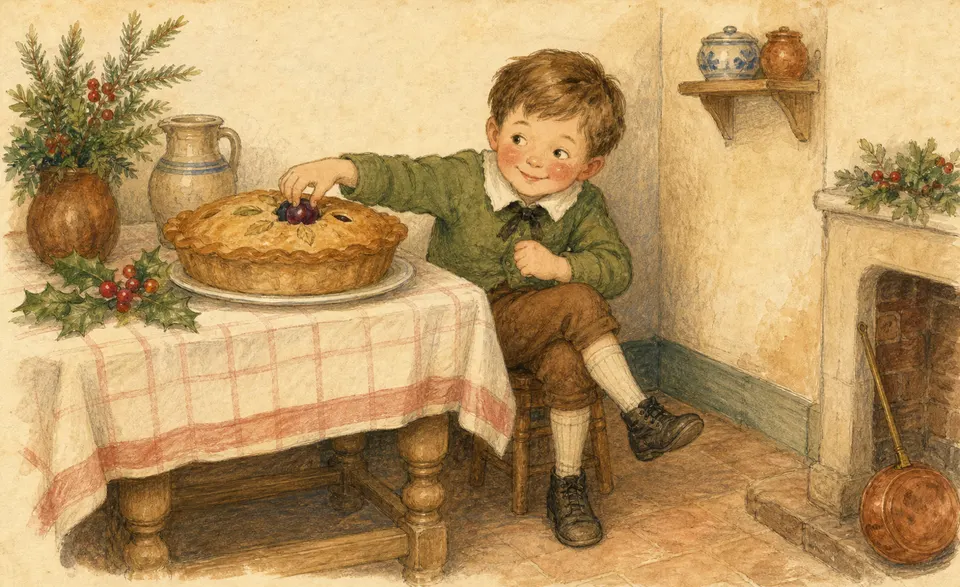
Little Jack Horner sat in the corner, Eating his Christmas pie. He put in his thumb and pulled out a plum, And said "What a good boy am I!"
#Little Jack Horner at a glance
- Country of origin
- 🇬🇧 United Kingdom
- Sung in
- English
- Words by
- Traditional
- First known
- 1725 (referenced); printed in full by 1791, possibly 1765
- Best for ages
- 2–7
- Mood
- playful, traditional, seasonal
- Last updated
- 27 August 2026
Meaning and origin
The charm of this rhyme is its faint smugness. Jack sits by himself, pulls a plum out of his pie with his thumb, and immediately praises his own goodness for doing it — a small, funny picture of a child pleased with himself for no very good reason. Henry Carey was already alluding to it in his satire Namby Pamby in 1725, and it was printed in full in Mother Goose’s Melody — perhaps in 1765, though the oldest surviving English edition is from 1791.
It also carries one of the better nursery-rhyme legends. In the nineteenth century a story spread that “Jack” was really Thomas Horner, steward to the last Abbot of Glastonbury in the reign of Henry VIII. As the tale goes, Horner was sent to London with a gift for the King — a pie in which the deeds to twelve manors were hidden — and on the way he lifted the lid, took out the deed to the manor of Mells, and kept it. The “plum” he pulled out, the story says, was that very manor.
It is a good tale, and it is not confirmed. Records do show that Thomas Horner came to own Mells, but later owners of Mells Manor have asserted that the legend is untrue and that the deed was bought from the abbey, and there is no evidence for the pie. Like so many rhymes, “Little Jack Horner” attracts a neat historical explanation that it cannot quite be made to prove.
Common questions
- How old is "Little Jack Horner"?
- The earliest reference to the verse is in "Namby Pamby", a satire by Henry Carey published in 1725. It was first written out in full in "Mother Goose's Melody", which may date from 1765, though the oldest surviving English edition is from 1791.
- Is the rhyme about a real Jack Horner?
- There is a well-known legend, but no proof. In the 19th century a story grew up that "Jack" was Thomas Horner, steward to the last Abbot of Glastonbury, who was sent to London with a pie hiding the deeds to twelve manors and quietly kept one — Mells in Somerset — for himself. Because the manor lands included lead mines in the Mendip Hills, the "plum" is said to pun on the Latin "plumbum", meaning lead. Records show Horner did come to own Mells, but later owners of Mells Manor have asserted that the legend is untrue and that the deed was bought from the abbey, and the tale cannot be confirmed.
- What does the rhyme actually say?
- On the surface, very little: a boy sits in a corner, digs a plum out of his Christmas pie with his thumb, and congratulates himself. That smugness is part of the joke — "what a good boy am I" for doing nothing but helping himself.