Lyrics
La letra completa de «Pin Pon» con traducción al inglés.
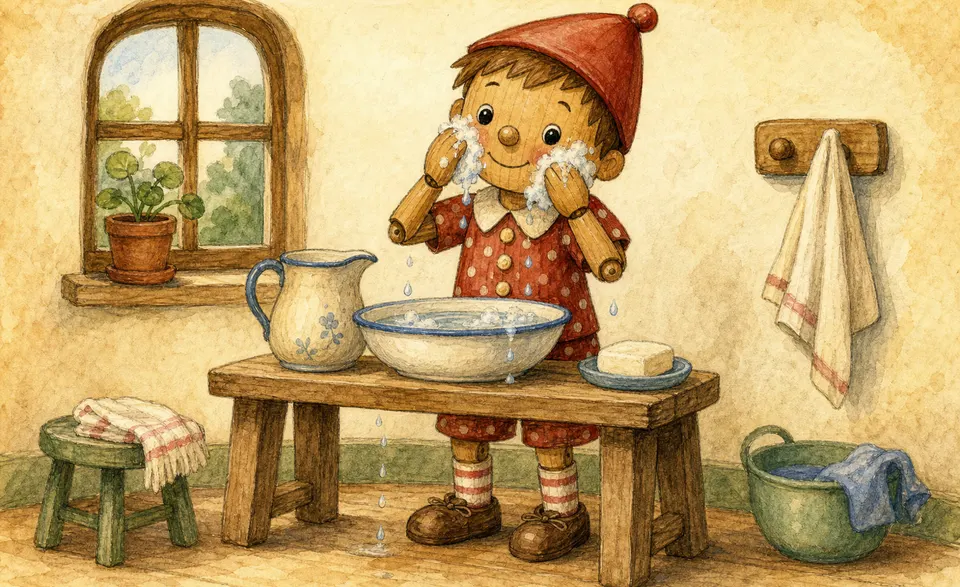
Pin Pon es un muñeco muy guapo y de cartón, de cartón. Se lava la carita con agua y con jabón, con jabón.
#English translation
Pin Pon is a doll, very handsome and made of cardboard, of cardboard. He washes his little face with water and with soap, with soap.
#Pin Pon at a glance
- Country of origin
- 🌐 Unknown
- Sung in
- Spanish
- Words by
- Traditional
- First known
- origin unknown; sung in kindergartens before 1968, when it was adapted for Chilean TV
- Best for ages
- 2–7
- Mood
- playful, traditional
- Last updated
- 27 August 2026
Meaning and origin
This is a gentle lesson in disguise. Pin Pon is a handsome little doll made of cardboard, and the whole song follows him through the small routines of looking after himself — washing his face with soap and water, combing his hair, going to bed on time. By watching the cheerful doll do these things, small children are coaxed into doing them too, which is why nursery teachers across the Spanish-speaking world have leaned on it for generations.
The song’s origin is unknown, but its fame has a clear source: a Chilean television character. From 1968 to 1971 the actor Jorge Guerra played a doll named Pin Pon on Canal 13’s children’s programming, and the show carried the song to audiences all over Latin America. Guerra himself was clear that he did not write it: the song “belongs to universal heritage; nobody knows its author”, he said — a kindergarten teacher had told him she already sang a song about a doll called José Pin Pon, and he took it over, changing only the melody of the second verse and turning the cardboard doll into a cotton one for television. Because no retrieved source names a country where the song began, this page leaves its country unknown rather than guessing from the language. What endures is the simplest of ideas — a friendly doll who keeps himself clean, and a tune catchy enough that children want to be just like him.
Common questions
- What is "Pin Pon" about?
- Good habits, made friendly. Pin Pon is a handsome doll made of cardboard who washes his little face with soap and water; further verses have him comb his hair, and go to bed on time. The song gently teaches small children to keep clean and tidy, using the doll as a model to copy.
- Where does "Pin Pon" come from?
- Nobody knows. The Chilean actor Jorge Guerra, who made it famous, said the song "belongs to universal heritage; nobody knows its author": a kindergarten teacher told him she already sang a song about a doll called José Pin Pon with her children, and he adapted it for his television programme, which ran on Chile's Canal 13 from 1968 to 1971. No country of origin is documented, so this page does not assign one.
- What did Jorge Guerra change in "Pin Pon"?
- By his own account, only two things: the melody of the second verse, and the doll's material — the kindergarten song's doll was "de cartón" (cardboard), and his television Pin Pon became "de algodón" (cotton). The cardboard doll sung here is therefore the older form.