Lyrics
Celotno besedilo pesmi »Diči, diči, diča« z angleškim prevodom.
Diči, diči, diča, urno na konjiča, na konjiča vranega, dobro osedlanega!
#Diči, diči, diča, deček nima biča, deček nima ni ostrog, da pognal bi konja v log.
#English translation
Diči, diči, diča, quick, onto the little horse, onto the little black horse, the well-saddled one! Diči, diči, diča, the boy has no whip, the boy has no spurs to drive the horse into the meadow.
#Diči, diči, diča at a glance
- Country of origin
- 🇸🇮 Slovenia
- Sung in
- Slovenian
- Words by
- Oton Župančič
- First known
- Poem "Na kolenu" by Oton Župančič, in the collection Pisanice (1900)
- Best for ages
- 2–7
- Mood
- playful, traditional
- Last updated
- 27 August 2026
How to sing it
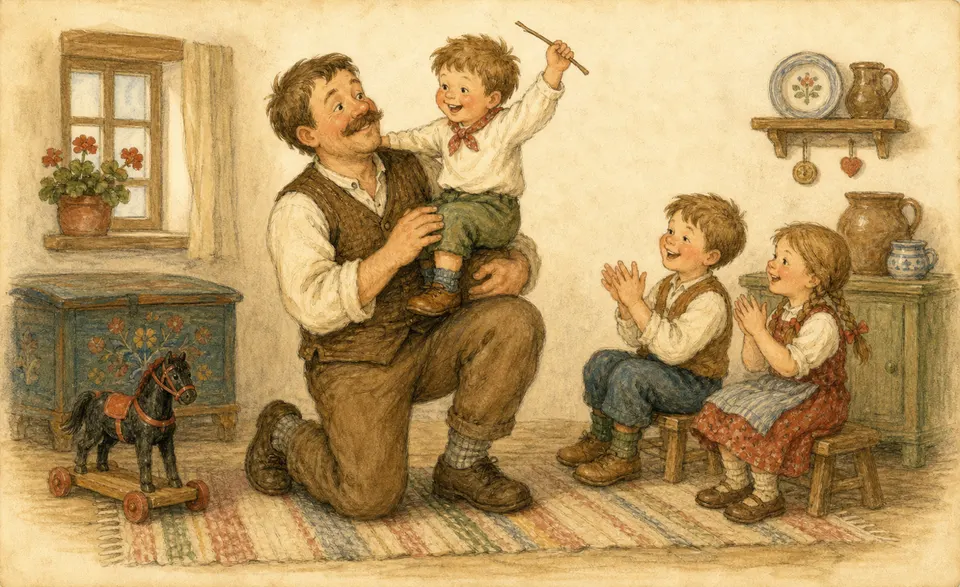
- Sit the child on your knees, facing you, and hold their hands.
- Bounce them gently in time as the little rider on the black horse.
- Jog a little faster on the galloping lines, then slow to a stop.
Meaning and origin
This is a Slovenian knee-riding rhyme, and its title says it all: Na kolenu, “on the knee”. A small child sits on a grown-up’s knees and is bounced in time, imagining themselves a rider on a fine black horse, “well saddled” and ready to go. It does exactly what knee-bouncing rhymes do in many languages — turns a lap into a saddle and a grown-up’s hands into reins.
The words keep the ride gentle and good-humoured. The little rider — the deček, the boy — has neither whip nor spurs to drive the horse off into the meadow, so there is no wild galloping, just a happy, steady bounce.
Although it is handed down in families as if nobody had written it, the rhyme has an author: Oton Župančič (1878–1949), one of the central figures of Slovenian poetry. “Na kolenu” appeared in Pisanice (1900), his first book of verse for young readers, a collection of playful pieces from his own recent childhood in Bela krajina — it stands there alongside other little children’s games such as “Pesem nagajivka” and “Zvezdice”. That a poet’s lines could slip so completely into the nursery that people forget they were ever composed is a measure of how well he caught the oldest pleasure there is: a child on a knee, a grown-up’s hands to hold, and a make-believe horse to ride.
Common questions
- How do you play "Diči, diči, diča"?
- As a knee-riding game — the poem's title, "Na kolenu", means "on the knee". You sit a small child on your knees and bounce them in rhythm, as though they were riding a fine, well-saddled black horse. It does the same job as the knee-bouncing rhymes found in many languages.
- What do the words say?
- They picture the ride: quick, onto the little horse — a black horse, well saddled! — but the little rider (the "deček", the boy) has no whip and no spurs to drive the horse into the meadow, which keeps the bouncing gentle and good-humoured.
- Who wrote "Diči, diči, diča"?
- The Slovenian poet Oton Župančič (1878–1949). The rhyme is his poem "Na kolenu" ("On the Knee"), which appeared in Pisanice (1900), his first book of verse for young readers, among what that collection calls its charming children's games. It is often passed on as if it were anonymous, but the words are his; because he died in 1949, the poem is now out of copyright.