Lyrics
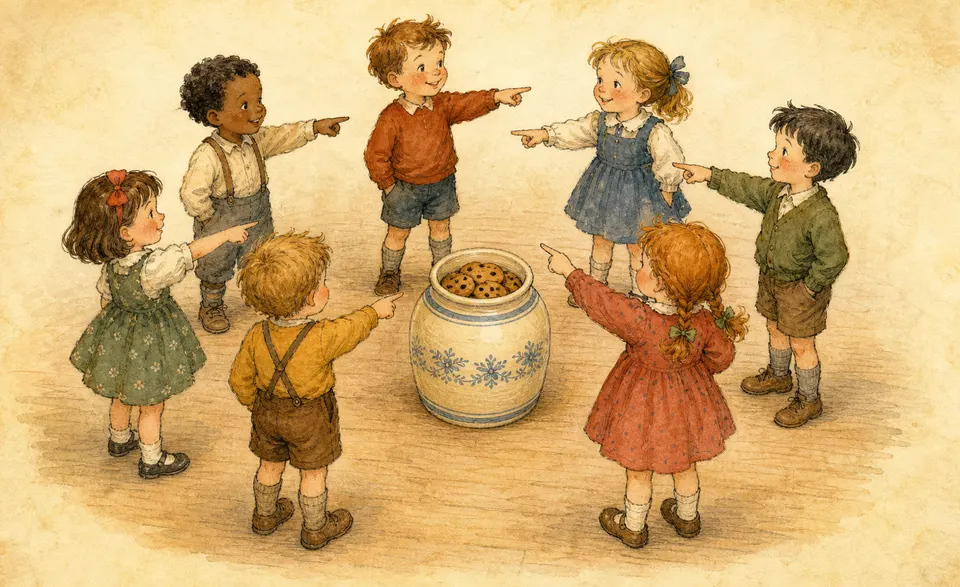
Group: (Tony) stole the cookie from the cookie jar! Child: Who, me? Group: Yes, you! Child: Couldn't be! Group: Then who? Child: (Kristi)!
#Group: (Kristi) stole the cookie from the cookie jar! (Continue with each child.)
#The Cookie Jar at a glance
- Country of origin
- 🌐 Unknown
- Sung in
- English
- Words by
- Traditional
- First known
- traditional group chant; author unknown
- Best for ages
- 2–7
- Mood
- playful, traditional
- Last updated
- 27 August 2026
How to sing it
- Keep a steady beat together — pat your knees, then clap, over and over.
- The group chants the accusation on the beat; the accused child answers back in rhythm.
- The accused names the next "thief", and the game rolls on around the circle.
Meaning and origin
This is less a song than a group game with a heartbeat. Everyone keeps a steady beat — a pat on the knees, then a clap — and over it the group accuses one child of stealing the cookie from the cookie jar. That child protests in perfect rhythm — Who, me? / Yes, you! / Couldn’t be! / Then who? — and points the finger at somebody else, who is accused in turn. Round and round it goes, and the real challenge is to answer without ever dropping the beat.
It has no known author, and no source consulted for this page records where or when it began — which is why this page lists no country of origin. It is a call-and-response chant passed on by ear, with countless small variations. Underneath the fun of the mock-trial, it is doing useful work: it drills a sense of steady rhythm, rewards quick listening and timing, and — since each round names a new child — pulls everyone in the circle into the game.
Common questions
- How does "Who Stole the Cookie?" work?
- As a call-and-response game with a steady beat. The group chants that one child "stole the cookie from the cookie jar"; that child protests — "Who, me? / Yes, you! / Couldn't be! / Then who?" — and passes the blame to another child, who is accused next. The challenge is to keep answering in time without breaking the rhythm.
- What is "The Cookie Jar" good for?
- Keeping a beat, listening, and quick thinking. Because everyone must stay on the clap-and-pat rhythm, it teaches timing and turn-taking, and it learns every child's name in the process.
- Who wrote "The Cookie Jar"?
- No author is recorded, and none of the sources consulted for this page says where or when the chant began, so no country of origin is given. It is a traditional group chant passed on by ear with many small variations.